serhii.net
In the middle of the desert you can say anything you want
-
Day 449 (24 Mar 2020)
Day 449
Random / Interesting
Why do color TVs make black and white snow? | Hacker News
The other question is “why don’t you see that noise when the TV is tuned in?” The TV has automatic gain control. When the signal is weak, it will amplify it up to the right level. If the signal is just background noise, then it will amplify that background noise until it’s at the “right level” for a proper TV signal. So, the gain is lower for stronger signals, and very high when there is no signal at all.
the artefacts created in the black and white picture by the colour signal are hardly noticeable, but they are enough to recover the colour from a black and white recording! The Unofficial Colour Recovery Wiki | Fandom
Programmer competency matrix
Programmer Competency Matrix – Sijin Joseph, I don’t agree with everything but looks like a nice blueprint
Random

Picture from xkcd what-if 0034 found on this article about evaluating LMs: Evaluation Metrics for Language Modeling and hotlinked from what-if 0034.
Qutebrowser
Added to
config.py:c.tabs.pinned.frozen = False c.tabs.title.format_pinned = "{current_title}"German / Deutsch
Cabinfever is der Lagerkoller.
-
Day 446 (21 Mar 2020)
Day 446
History is happening
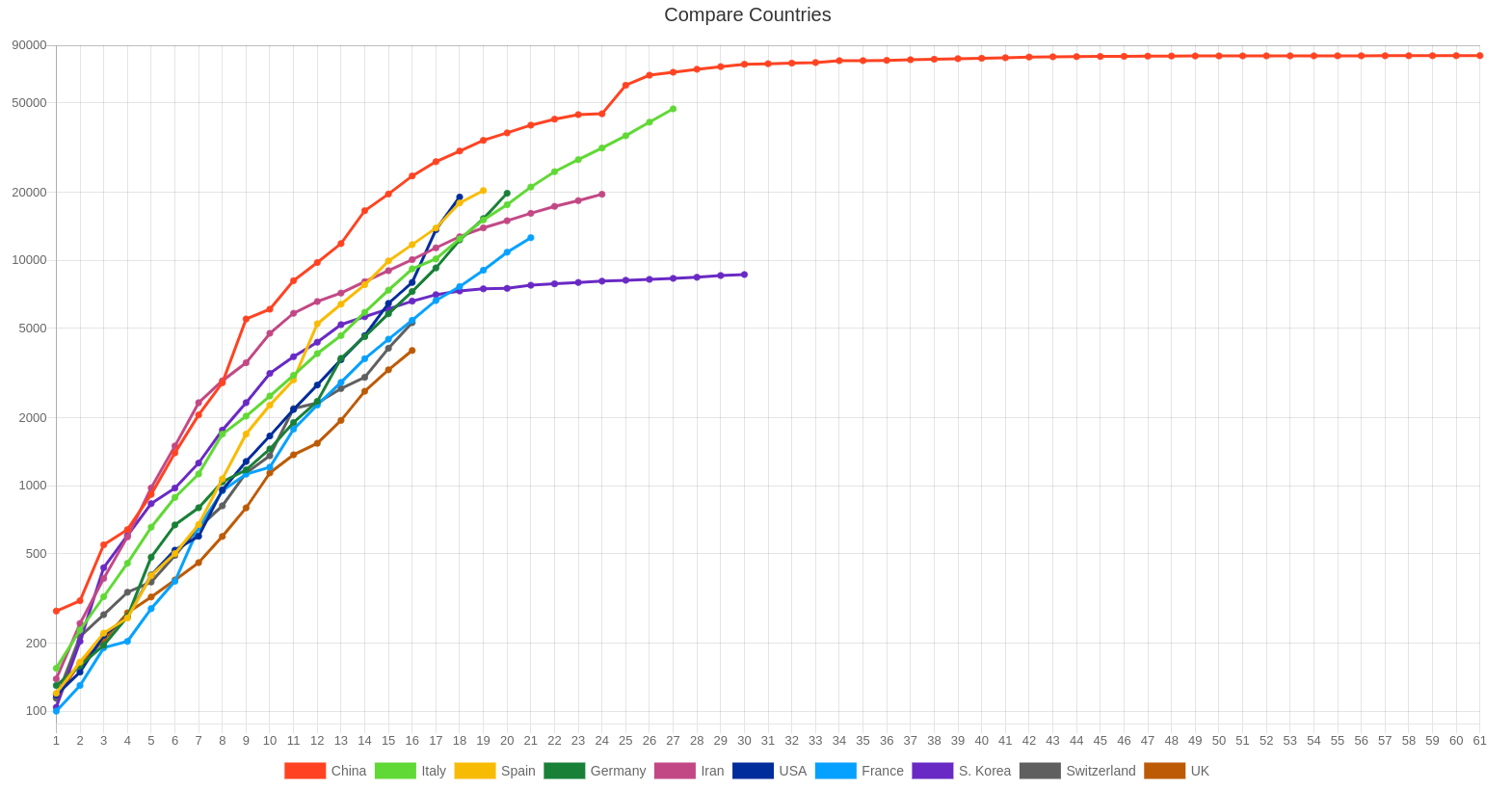
My favourite corona-Dashboard has a nice new option to “align by date of 100th case”: Coronavirus charts
It looks like this today:
-
Day 444 (19 Mar 2020)
Day 444
Changed font in the Terminal
Changed the font from Fira Code Light to Fira Code Medium (EDIT: now Bold. True-bold text still gets rendered as extra-bold, which is very nice too!). It works much better on not-bright-enough screens that stand in front of too-bright windows.
Tensorflow saving model weird errors about init things
I could not save a Tensorflow Keras model, the issue was that I passed arguments from init as:
self.whatever = whatever, then changedself.whateverto a different data type (string to b’ytes’ w/.encodein my case), then in theget_config()function then I happily said{'whatever': self.whatever,}which then could not beencode()’d.Random / interesting
Granular convection - Wikipedia is the process where biggerr parts of something float above when surrounded by smaller parts of something and vibration.
History is happening
I’m not sure this is the place for this (oh wait, my blog, I decide the rules, it is now), but since the universe is interesting right now, I feel like preserving some parts. Not necessarily like a diary, just links that I feel will represent this interesting time better than many words could.
-
Day 443 (18 Mar 2020)
Day 443
Githubusing keys instead of passphrase
This is very nice and concise: Setup SSH keys for use with GitHub/GitLab/BitBucket etc, along with this series: Generating a new SSH key and adding it to the ssh-agent - GitHub Help
TL;DR generate a key, add it to Github, add it to the
ssh-agentas$ eval "$(ssh-agent -s)" > Agent pid 59566 $ ssh-add ~/.ssh/id_rsaTest the results as
→ ssh -T git@github.com
Hi username! You've successfully authenticated, but GitHub does not provide shell access.
If the key is in a non-default location,
Host github.com HostName github.com User jaeaess IdentityFile ~/.ssh/id_rsa_github_jaeaessis needed in the~/.ssh/configfile.To push without being asked for passwords, the remote needs to be changed from HTTPS to SSH:
$ git remote remove origin
$ git remote add origin git@github.com:AquilineAdaeze/gitformyMac.git
Since it doesn’t seem to be persistent, the unsafe way (even though it’s considered unsafe in general) is to add
ssh-add -q ~/.ssh/id_rsa_githubto startup.Intellij Idea copy absolute path
To copy absolute path of a file,
Ctrl+Shift+Cworks.Transformer Keras load a trained model and do some changes
Very interesting discussion: Loading a trained model, popping the last two layers, and then saving it · Issue #8772 · keras-team/keras
For the Sequential model,
model.pop()also exists but not for the Functional one.For a Functional model, after getting a model from an .h5 file, we can do things such as:
new_model = Model(model.inputs, model.layers[-3].output)
-
Day 442 (17 Mar 2020)
Day 442
Keras / Tensorflow why saving a subclassed model is hard
Very nice R-centric explanation, but should be valid for Python too: Saving and serializing models
A subclassed model differs in that it’s not a data structure, it’s a piece of code. The architecture of the model is defined via the body of the call method. This means that the architecture of the model cannot be safely serialized. To load a model, you’ll need to have access to the code that created it (the code of the model subclass). Alternatively, you could be serializing this code as bytecode (e.g. via pickling), but that’s unsafe and generally not portable.
TODO Tensorflow model saving / prediction
Why am I getting wildly different accuracies and losses after loading the model from
.h5file, whenmodel.weightsfor both are identical and predictions (usingmodel.predict()) too? This probably has something to do with me misunderstanding datasets, how exactly?Tensorflow/Keras
-
Day 441 (16 Mar 2020)
Day 441
Qutebrowser
tab-givekeybindingAdded
config.bind('tg', 'set-cmd-text -s :tab-give')to qutebrowserconfig.py.set-cmd-textis nice,-smeans add space to the end, and now I know more about qutebrowser modes in general - for example, I can do keybindings even while I’m inserting a:command. The further it goes the more I love qutebrowser.Intellij idea debugger
Debug tool window - Help | IntelliJ IDEA
If I click and the Debugger pane disappears,
Alt+5makes it appear again in the previous state.catcompressed files withzcatThis is very nice:
zcat auth.log.3.gzChoose default webcam
lenovo - 18.10: how to set system default webcam? - Ask Ubuntu
mv /dev/video0 /dev/video0.original
ln -s /dev/video2 /dev/video0
-
Day 437 (12 Mar 2020)
Day 437
Toread
How to Make Yourself Into a Learning Machine - Superorganizers - fascinating practical use of the Zettelkasten method, amongst other things - don’t have time for this now but I will read it later. + Using Anki to Remember Everything You Read | Hacker News as my source.
Adding to this:
- Having Had No Predecessor to Imitate, He Had No Successor Capable of Imitating Him | Fantastic Anachronism and How Do We Know That Epic Poems Were Recited from Memory? | Hacker News
TODO Qutebrowser
- Create a better
ymthat automatically escapes things like| - Resurrect pchr8.net/f/ since I really really miss it as my place to organize stuff
-
Day 436 (11 Mar 2020)
Day 436
Tensorflow Keras reset states of everything
Everytime I call
model.fit()it does NOT reset the weights, DOES reset the hidden states (such as RNN/LSTM), does NOT reset optimizer settings. machine learning - keras.fit() re-initialises the weights - Stack OverflowIf I want to reset them,
keras.backend.clear_session()should clear the info from the previous model.
-
Day 430 (05 Mar 2020)
Day 430
German - Geburtsname
Geburtsname: Vorname oder Nachname - Das versteht man darunter - FOCUS Online
Müssen Sie in einem Formular Ihren Geburtsnamen angeben, handelt es sich um Ihren Nachnamen, den Sie bei Ihrer Geburt erhalten haben. Sofern Sie nicht geheiratet und den Namen Ihres Ehemanns oder Ihrer Ehefrau angenommen oder eine Namensänderung beantragt haben, können Sie hier Ihren aktuellen Nachnamen angeben.
Bash/terminal command with a certain percent chances of running
[ $[$RANDOM % 10] = 0 ] && do_this || do_that“s gives roughly a 1 in 10 chance ofdo_thisrunning, and a 9 in 10 chance ofdo_thatrunning. You can omit||do_thatto just have a 10 percent chance ofdo_thisrunning.” (seen here: Clear Your Terminal in Style - Adam.)Vim vimmotion plugin in visual mode
The vim vim-easymotion plugin (easymotion/vim-easymotion: Vim motions on speed!) also works in select/visual mode!
EDIT: there’s an intellij idea plugin! Just wow
Intellij Idea / Ideavim / Easymotion plugin
I’m very very very glad about this, this is one thing that I missed from vim! AlexPl292/IdeaVim-EasyMotion: EasyMotion emulation plugin for IdeaVim
To activate I had to add
set easymotionafter setting the leader key in.ideavimrc.I just to not-forget about it.
-
Day 429 (04 Mar 2020)
Day 429
Python imports
Python ‘No module named’ error; ‘package’ is not a package - Stack Overflow TL;DR Beware of conflicting filenames.
I keep getting bitten by this - if I have a folder called
somethingand inside it something calledsomething.pyand want to import something from the folder, it will takesomethingto meansomething.pyinstead of the folder.Quoting the most helpful answer:
I was using the same name for both a sub-package (directory) and a module (file) within it.
For example I had this:
    /opt/mylib/myapi
    /opt/mylib/myapi/__init__.py
    /opt/mylib/myapi/myapi_creds.py        # gitignored file for user/pass
    /opt/mylib/myapi/myapi.py              # base module, load creds and connect
    /opt/mylib/myapi/myapi_dostuff.py      # call myapi.py and do work
The script ‘myapi.py’ imports credentials from myapi_creds.py via this statement:
    from myapi.myapi_creds import my_user, my_pass

Testing the module 'myapi.py' resulted in this error:

    $ ./myapi.py
    Traceback (most recent call last):
      File "./myapi.py", line 12, in <module>
        from myapi.myapi_creds import my_user, my_pass
      File "/opt/mylib/myapi/myapi.py", line 12, in <module>
        from myapi.myapi_creds import my_user, my_pass
    ModuleNotFoundError: No module named 'myapi.myapi_creds'; 'myapi' is not a package
The solution was to rename
myapi.pytomyapi_base.pyso it’s name does not collide with the sub-package name.Markdown code in quotes
Is there a way to put code blocks in block quotes? - Meta Stack Overflow TL;DR Code is indented four spaces, but inside a quote (
>) they have to be indented five spaces.English - dingbat
dingbat - Wiktionary - crazy person - typographical ornament (like arrows) - small device/gadget the correct term for which is forgotten/unknown
Scipy normality test
scipy.stats.normaltest — SciPy v1.4.1 Reference Guide - function returns amongst other things p-value that the sample comes from a normal distribution.
Meaning of
buffer_size=indataset.shuffle()It affects how random the shuffle is. A buffer size of 1 would not shuffle at all, one bigger than the dataset would be perfect. It’s basically the size of the randomly created bucket from which we pick the next element.